Aluminum-air batteries have long been celebrated for one headline number: an enormous theoretical energy density of roughly 8,100 Wh per kilogram of aluminum, rivaling gasoline and dwarfing lithium-ion. Yet for decades the chemistry carried a quiet asterisk. It could store a lot of energy, but it struggled to deliver that energy quickly. High power output, the ability to push large currents on demand, remained the technology's stubborn bottleneck.
A 2026 peer-reviewed study from researchers at the University of Tennessee, Knoxville and Oak Ridge National Laboratory changed that calculus. By systematically tuning how the aluminum surface behaves during discharge, the team demonstrated a peak power density of 710 mW/cm² — to their knowledge the highest ever reported for an aluminum-air battery when measured against the surface area of the aluminum anode itself. This article breaks down how they did it and why the result matters for anyone building real-world clean-energy systems.
The Real Bottleneck: A Passivation Film You Can't See
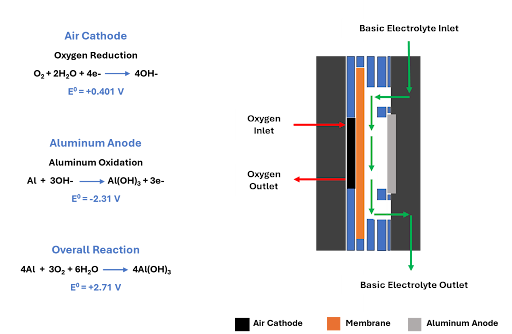
When an aluminum-air battery discharges, aluminum at the anode reacts with hydroxide ions to release electrons — the useful current. But that same reaction produces aluminum hydroxide, an insoluble solid that aggregates into a porous layer right at the metal surface. Researchers call this a secondary passivation layer. It sits on top of the fresh aluminum and physically impedes the electrolyte from reaching active sites.
At low current, this film barely matters. At high current — exactly where you need power — it becomes the dominant source of loss. The study is direct on this point: at high rates of discharge, cell performance is largely dictated by ohmic losses at the anode associated with the aluminum product layer. In plain terms, the battery chokes on its own byproduct.
The Fix: Turn the Film Over Faster
The insoluble hydroxide film is not permanent. It can be converted into a soluble aluminate ion and washed away, continuously exposing fresh metal. The rate of this dissolution turns out to be the single most important lever for high-power performance. The researchers approached it from three complementary directions.
1. Higher alkalinity (electrolyte concentration)
Increasing potassium hydroxide (KOH) concentration accelerates the breakdown of the passivation film. The team found that 6 M and 8 M KOH performed similarly, so they selected 6 M as the optimum — achieving the benefit while using less material.
2. Higher temperature
Warming the electrolyte to 70 °C sharply improved both reaction kinetics and transport. Impedance at high temperature dropped by more than an order of magnitude compared with room temperature. Above 70 °C, corrosion began to dominate — so 70 °C emerged as the practical sweet spot.
3. A tin-depositing corrosion inhibitor
Adding sodium stannate (Na₂SnO₃) to the electrolyte deposits a thin layer of tin onto the aluminum. Tin suppresses the wasteful hydrogen-evolution side reaction and, importantly, interrupts the buildup of the resistive hydroxide film. The team identified a "critical tin deposition" threshold and settled on 0.1 M as the representative concentration.
4. Faster electrolyte flow
Finally, circulating the electrolyte faster (30 mL/min in their full cell) uses shear to sweep reaction products off the surface. This mattered most at the highest discharge rates and over longer discharge periods, where product buildup would otherwise strangle performance.
The Result: A New Benchmark
Stacked together, these changes took a baseline cell running at just 64 mW/cm² to a peak of 710 mW/cm² in polarization testing, with 680 mW/cm² sustained in extended discharge. For comparison, the study notes the previous best reported on a comparable aluminum-area basis was 381 mW/cm². Crucially, the team also preserved strong energy density — around 2,500 Wh/kg of aluminum at a 500 mA/cm² discharge rate — so the power gains did not come at the expense of the chemistry's core advantage.
This investigation emphasizes the greater relevance of film impedance compared with reaction selectivity when operating at high aluminum overpotentials — the surface layer, not the chemistry itself, is the frontier.
Why This Matters Beyond the Lab
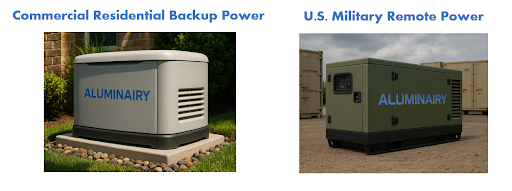
Power density decides which applications a battery can actually serve. A high-energy, low-power system is fine for a trickle load, but backup generators, electric aircraft, and grid-support hardware all demand bursts of current. By showing that careful management of the aluminum product layer unlocks record power without sacrificing energy density, this work moves aluminum-air from an interesting lab curiosity toward a genuinely deployable power source.
At AluminAiry, this film-management principle is central to how we design real systems: control the surface, control the power. It is the difference between a chemistry that looks good on paper and one that keeps the lights on.
Curious how this translates into a product for your home, facility, or fleet? Explore our technology or get in touch to discuss a pilot.