




AluminAiry

Power from
recycled
aluminum.

AluminAiry builds aluminum-air generators for the loads that cannot go dark, and the electrodes and membranes other energy companies build with. The fuel is aluminum that would otherwise be landfilled. The byproduct is sold. Nothing burns.

Gloved hands connecting electrolyte lines to an aluminum-air test cell on a lab bench
Cell voltage
1.0–1.2 V
System voltages
12 · 24 · 60 V
Electrolyte
Water-basedNon-flammable
Operating emissions
None
Byproduct
Al(OH)₃Aluminum trihydroxide, sold on
01What we buildTwo product lines, one electrochemistry.

Power systems / generators

Aluminum-air generators
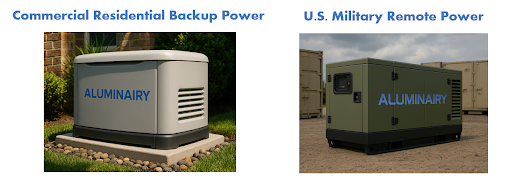
Two AluminAiry generator concepts: a residential standby unit on a pad and a ruggedized military remote-power unit
Fig. 1 Residential/commercial standby unit (left) and U.S. military remote-power unit (right), concept.

Standby and primary power for homes, facilities, and remote military sites. Refueled by swapping aluminum plates instead of recharging or refilling a tank. No combustion, no fuel storage, no downtime.

  • Residential and commercial backup
  • Hospitals, data centers, telecom, manufacturing
  • Military field operations and off-grid sites
  • Series-configurable to 12, 24, or 60 volts

Solutions by application

Energy materials / components

Electrodes, membranes & catalysts

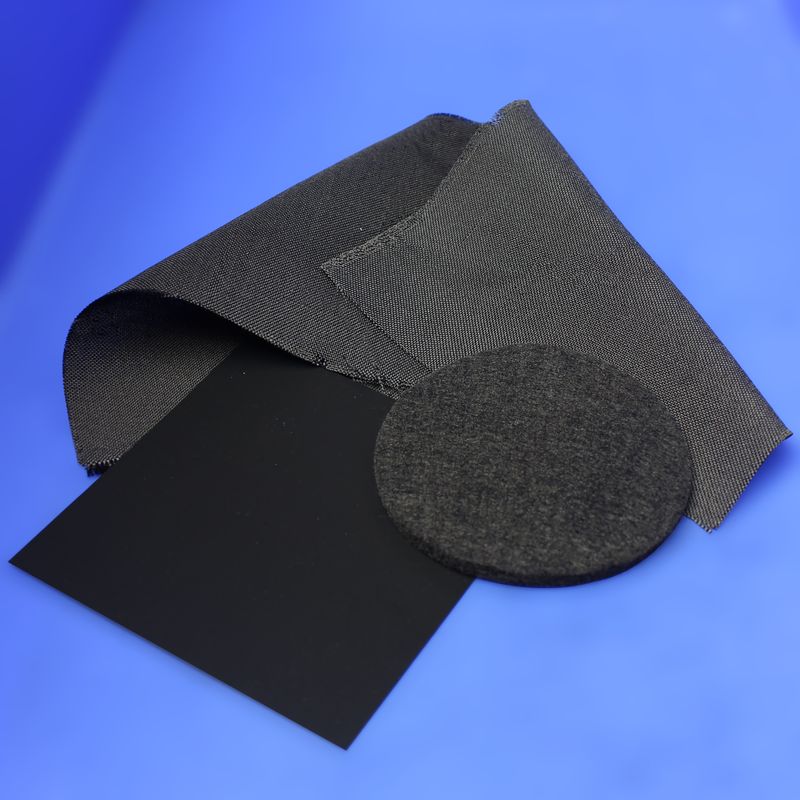
Sheets and discs of black gas diffusion layer carbon paper on a blue background
Fig. 2 Gas diffusion layers cut to standard sheet and small-scale form factors.

Gas diffusion electrodes, catalyst-coated membranes, and catalysts for fuel cells, metal-air batteries, and flow batteries. Small-batch and pilot-scale, made in the United States.

  • Pt/C and MnO₂ catalysts, or electrodes from yours
  • Sigracet and Toray GDLs, Nafion membranes
  • 1–5 cm² coupons up to 40 × 40 cm sheets
  • Up to 20% cheaper and 25% faster than large suppliers

Materials catalog

02Why aluminumAgainst the two defaults.

Facilities that need power through an outage usually choose between a diesel generator and a lithium-ion battery bank. Aluminum-air removes the things that make each one expensive to own.

Aluminum-airDiesel generatorLithium-ion storage
FuelRecycled aluminum plateDiesel, commodity-pricedGrid electricity
Flammable on siteNo. Water-based electrolyteYes. Fuel storage, fire code, suppressionYes. Thermal runaway risk
Operating emissionsNoneCO₂, NOx, particulates. Permits and reportingNone on site
Refuel or rechargeMechanical plate swap. No downtimeFuel delivery. Oil, filters, exhaust after-treatmentHours on a grid that is down during the outage
Critical mineralsNoneNoneLithium, cobalt, nickel
What is left overAl(OH)₃, sold to secondary marketsExhaustSpent cells
03The reactionAluminum in. Air in. Electricity out.
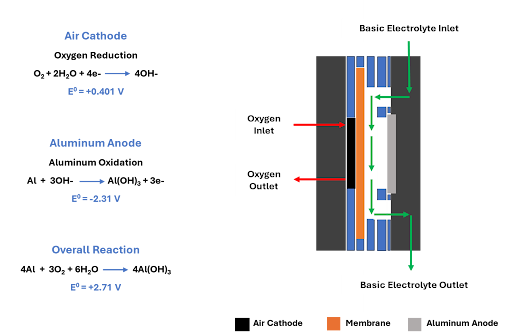
Cross-section of an aluminum-air cell: aluminum anode, water-based electrolyte, membrane, air cathode, with electrons flowing through an external load LOAD e⁻ → → e⁻ Aluminum anode Water-based electrolyte Air cathode Membrane Recycled Al plate(fuel, swapped) Ambient airO₂ in Electrolytecirculation Al(OH)₃ out, sold
Fig. 3 Aluminum-air cell, cross-section. Not to scale.

An aluminum plate oxidizes at the anode and gives up electrons. Oxygen from ambient air is reduced at the cathode and takes them back. The electrolyte carries hydroxide between the two. The electrons take the long way around, through your load.

AnodeAl + 3OH⁻ → Al(OH)₃ + 3e⁻E° = −2.31 V
CathodeO₂ + 2H₂O + 4e⁻ → 4OH⁻E° = +0.40 V
Overall4Al + 3O₂ + 6H₂O → 4Al(OH)₃E° = +2.71 V

Practical cell voltage under load is 1.0–1.2 V. Cells are stacked in series to reach 12, 24, or 60 volts. A 2026 peer-reviewed study reached a record 710 mW/cm² peak power density for the chemistry. Read more on the technology page.

04Closing the loopSixty percent of cans are buried.

About 1.3 GWh of energy is buried every year in cans alone.

Sixty percent of aluminum cans in the United States end up in a landfill, and the energy that went into smelting them goes with them. Our generators pull that energy back out as electricity, and the aluminum trihydroxide that remains is sold into secondary markets. The loop has four stops.

  1. Secure

    Aluminum, pre- and post-consumer, in all forms from suppliers, partners, and recyclers.

  2. Convert

    Aluminum is prepared as plate fuel and loaded into the generator.

  3. Generate

    Electricity is produced on site. No grid, no emissions, no noise.

  4. Recover

    Aluminum trihydroxide is collected and sold, and the cycle starts again.

A dense pile of crushed post-consumer aluminum beverage cans
Fig. 4 Post-consumer cans, the feedstock for aluminum plate fuel.
05Who backs usInvestors, partners, supporters.
UT Research Foundation Tickle College of Engineering, University of Tennessee Haslam College of Business, University of Tennessee Knoxville DEVCOM Army Research Laboratory Tennessee Valley Authority Spark Cleantech Accelerator U.S. Department of Energy Oak Ridge National Laboratory Vertx Partners

Founded in Knoxville, Tennessee. Supported by the University of Tennessee Research Foundation, the Tickle College of Engineering, the Haslam College of Business, DEVCOM Army Research Laboratory, the Tennessee Valley Authority, and the Department of Energy (DOE). Winner of the University of Tennessee Chancellor's Innovation Fund award, 2025, and the TVA x Spark Award, 2024.

Bring us your aluminum.
Or your capital.

Recyclers, facilities operators, research partners, and investors all have a place in the loop.

OfficeKnoxville, Tennessee